Monday, January 19, 2009

The "Wisdom" of George W. Bush


From BBC News:

All politicians are prone to make slips of the tongue in the heat of the moment - and President George W Bush has made more than most.

The word "Bushism" has been coined to label his occasional verbal lapses during eight years in office, which come to an end on 20 January.

Here are some of his most memorable pronouncements.

ON HIMSELF

"They misunderestimated me."
Bentonville, Arkansas, 6 November, 2000

''I know what I believe. I will continue to articulate what I believe and what I believe - I believe what I believe is right." Rome, 22 July, 2001

"There's an old saying in Tennessee - I know it's in Texas, probably in Tennessee - that says, fool me once, shame on... shame on you. Fool me - you can't get fooled again."
Nashville, Tennessee, 17 September, 2002

"There's no question that the minute I got elected, the storm clouds on the horizon were getting nearly directly overhead."
Washington DC, 11 May, 2001

"I want to thank my friend, Senator Bill Frist, for joining us today. He married a Texas girl, I want you to know. Karyn is with us. A West Texas girl, just like me."
Nashville, Tennessee, 27 May, 2004

FOREIGN AFFAIRS
"For a century and a half now, America and Japan have formed one of the great and enduring alliances of modern times."
Tokyo, 18 February, 2002

"The war on terror involves Saddam Hussein because of the nature of Saddam Hussein, the history of Saddam Hussein, and his willingness to terrorise himself."
Grand Rapids, Michigan, 29 January, 2003

"Our enemies are innovative and resourceful, and so are we. They never stop thinking about new ways to harm our country and our people, and neither do we." Washington DC, 5 August, 2004

"I think war is a dangerous place." Washington DC, 7 May, 2003

"The ambassador and the general were briefing me on the - the vast majority of Iraqis want to live in a peaceful, free world. And we will find these people and we will bring them to justice."
Washington DC, 27 October, 2003

"Free societies are hopeful societies. And free societies will be allies against these hateful few who have no conscience, who kill at the whim of a hat."
Washington DC, 17 September, 2004

"You know, one of the hardest parts of my job is to connect Iraq to the war on terror."
CBS News, Washington DC, 6 September, 2006

EDUCATION

"Rarely is the question asked: Is our children learning?"
Florence, South Carolina, 11 January, 2000

"Reading is the basics for all learning."
Reston, Virginia, 28 March, 2000

"As governor of Texas, I have set high standards for our public schools, and I have met those standards."
CNN, 30 August, 2000

"You teach a child to read, and he or her will be able to pass a literacy test.''
Townsend, Tennessee, 21 February, 2001

ECONOMICS

"I understand small business growth. I was one."
New York Daily News, 19 February, 2000

"It's clearly a budget. It's got a lot of numbers in it."
Reuters, 5 May, 2000

"I do remain confident in Linda. She'll make a fine Labour Secretary. From what I've read in the press accounts, she's perfectly qualified."
Austin, Texas, 8 January, 2001

"First, let me make it very clear, poor people aren't necessarily killers. Just because you happen to be not rich doesn't mean you're willing to kill."
Washington DC, 19 May, 2003

HEALTHCARE
"I don't think we need to be subliminable about the differences between our views on prescription drugs."
Orlando, Florida, 12 September, 2000

"Too many good docs are getting out of the business. Too many OB/GYN's aren't able to practice their love with women all across the country."
Poplar Bluff, Missouri, 6 September, 2004

TECHNOLOGY
"Will the highways on the internet become more few?"
Concord, New Hampshire, 29 January, 2000

"It would be a mistake for the United States Senate to allow any kind of human cloning to come out of that chamber."
Washington DC, 10 April, 2002

"Information is moving. You know, nightly news is one way, of course, but it's also moving through the blogosphere and through the Internets."
Washington DC, 2 May, 2007

OUT OF LEFT FIELD
"I know the human being and fish can coexist peacefully."
Saginaw, Michigan, 29 September, 2000

"Families is where our nation finds hope, where wings take dream."
LaCrosse, Wisconsin, 18 October, 2000

"Those who enter the country illegally violate the law."
Tucson, Arizona, 28 November, 2005

"That's George Washington, the first president, of course. The interesting thing about him is that I read three - three or four books about him last year. Isn't that interesting?"
Speaking to reporter Kai Diekmann, Washington DC, 5 May, 2006

ON GOVERNING
"I have a different vision of leadership. A leadership is someone who brings people together."
Bartlett, Tennessee, 18 August, 2000

"I'm the decider, and I decide what is best."
Washington DC, 18 April, 2006

"And truth of the matter is, a lot of reports in Washington are never read by anybody. To show you how important this one is, I read it, and [Tony Blair] read it."
On the publication of the Baker-Hamilton Report, Washington DC, 7 December, 2006

"All I can tell you is when the governor calls, I answer his phone."
San Diego, California, 25 October, 2007

"I'll be long gone before some smart person ever figures out what happened inside this Oval Office."
Washington DC, 12 May, 2008

http://news.bbc.co.uk/2/hi/americas/7809160.stm

Rural Americans remain skeptical about Obama Presidency


Washington Post reporter Anne Hull recently visited with residents of Brinkley,Arkansas to discuss their attitudes about the incoming Obama Presidency. Like ten other counties in Arkansas, Marion County voted for John Kerry in 2004 but favored John McCain in 2008. Arkansas has remained one of the more Democratic states in the South but for how long ? The January 16 Washington Post article is a reminder is the disconnect in America between rural communities and more urbanized areas. Democrats still have trouble relating to rural voters and not just in Arkansas where the problem is more obvious as rural voters still dominate the state's electoral politics. Check out this map to see the red vs. blue split in the 2008 election which is largely rural vs. urban. http://www-personal.umich.edu/~mejn/election/2008/countymapredbluer1024.png

The Obama Administration must have a strong outreach to rural America, programs to help small towns become more economically viable and to stay away from the gun control issue. Divisive matters like gay marriage and abortion have not helped Democrats in rural America but perceptions of being hostile to gun ownership have done as much or more political damage.

Hull writes:

Wayne Loewer’s truck reveals a lot about his life. A 12-gauge shotgun for duck hunting rests on the floorboard. A blue thermal lunch bag containing elk meat is shoved under the seat, left in haste that morning by his teenage son rushing to catch the school bus.

Binoculars in the console help Loewer scan his 2,900 acres of rice, soybeans and corn.

The dashboard radio is set to classic rock, playing the same Lynyrd Skynyrd tunes from Loewer’s high school days, when Brinkley was a thriving small town with stores and a movie theater.

His muddy truck is 900 miles from the kiosks crowding Pennsylvania Avenue selling “Hope Won” T-shirts. But more than miles separate Loewer from the coming celebration in Washington over Barack Obama’s inauguration as president.

The 52-year-old farmer is a conservative Democrat who bet on Republican John McCain and lost, a description that would apply to many in the white South. Now Loewer wonders about his place in Obama’s America.

“I’m worried that he’s not gonna understand the rural way of life,” he says.

On this cold January morning, Loewer makes his morning rounds — the irrigation company, the seed distributor, a well supplier — and everywhere he goes, the same anxieties are expressed.

“That comment he made about guns and religion, it’s frightening, you have to admit,” says the secretary at his accountant’s office.

Loewer agrees. “I don’t believe in going around with a gun strapped to your hip, Wild West-style,” he says. “But you ought to be able to protect yourself.”

He understands the cultural chasm between him and Obama’s Ivy League, biracial, global polish. He realizes he is set apart from the 53 percent majority that put Obama in the White House.

Loewer is not bitter. He is eager to see how Obama will govern.

Still, on the eve of the inauguration, a sense of apprehension prevails in a place that rejected the new president and now warily awaits his version of America.

Brinkley is halfway between Little Rock and Memphis, Tenn. Few things break the quiet — the sound of geese, the 18-wheelers winding by on Interstate 40 or a train whistle blowing from the tracks that run through downtown.

These Delta lowlands are perfect for duck and deer hunting and for growing rice, which Loewer farms just as his father did.

The rural way of life that Loewer describes has its problems. In Brinkley, they include closed-up storefronts, a population that has shrunk to 3,300, a poor education system and meager income levels. Locals say the recession hitting the nation is felt less here because there was no housing or job boom to begin with.

In a presidential election in which the country went solidly Democratic, Arkansas turned a deeper shade of red. Obama didn’t campaign in the state, which may partially explain his loss here to McCain by 20 points, but the defeat also reveals the complexities of the country he inherits, particularly in Appalachia and the upland South.

Eleven counties in Arkansas switched their allegiance from the Democratic presidential candidate in 2004 to the Republican in 2008. This includes Monroe County, where, even with an black population of 40 percent, McCain beat Obama by three points.

Robert Serio, chairman of the local Democratic Party for 30 years, says Obama was viewed as too liberal in Monroe County.

“We don’t look at national Democrats as being family-oriented,” says Serio, a lawyer. “The multicultural thing would be something we are opposed to. The homosexual question would have an impact.”

Serio declined to say whom he voted for.

Wayne Loewer defies rigid categorization. A Blue Dog Democrat like many in Arkansas, he voted for Bill Clinton and George W. Bush. Church plays no role in his life. He supports a woman’s right to choose whether to have an abortion.

He thought a McCain administration would be just a continuation of Bush’s, and he was tired of Bush and what he saw as a failed war in Iraq. He thought Obama’s farm policies were stronger than McCain’s.

But he says Obama lost his support when he made his infamous remarks at a private fundraiser in San Francisco about small-town Americans who feel marginalized and “cling to guns or religion.”

Guns define Loewer’s life. He grew up walking the woods with a rifle. He worked as a guide during duck season for extra income. His deep freezer is full of game that he grills with Cajun seasoning or portobello mushrooms for family dinners. There are few better feelings than the one he gets taking his 14-year-old son hunting and teaching him about white-tailed deer.

“We depend on our guns in the South,” he says. One of his favorite bumper stickers reads, “If you want more gun control, use two hands.”

Not long after Obama’s comments, Loewer received mailers from the National Rifle Association saying that Obama planned to ban hunting, restrict gun laws and close 90 percent of gun shops. Several nonpartisan fact-checking groups discredited the claims, but the gun dealers Loewer talked to said the NRA had it right.

“When Obama got elected, I went out and bought a rifle and pistol shells for every weapon I own,” he says. “I bought $400 worth of ammo.”

Not that Loewer feared Armageddon or a race war; he was stocking up in case the warnings from the NRA and the gun dealers came true.

Some of his alarm has subsided. Obama seems focused on the economy. His appointments so far have been centrist and solid, though it is widely noted in Brinkley that no Southerner has been nominated to any top post.

“Payback time,” Loewer says, for the South’s rejection of Obama.

He has noticed that blacks around Brinkley — many whose families originally came to this region to pick cotton — have a newly emboldened attitude. He’s heard about people cutting in line at the grocery store or “doing a little victory dance at the Kwik Shop.”

Loewer shrugs.

“If he brings us out of this mess we’re in right now, I’ll get out in the street and fist bump with them,” he says.

With planting season two months away, Loewer is monitoring fertilizer and fuel prices so he can lock in a good rate. The volatility of the market makes everything harder. The cost of gasoline has risen 30 cents in the past four days.

Obama never campaigned in Arkansas, but if he had come to the Delta region he would have seen a primeval beauty with a summer heat so punishing that farm hands walk the rice fields with jugs of water strapped to their sides.

He would have also faced men in feed caps who mistrusted his message of optimism.

“Obama has almost no history with the South,” Loewer says, sitting across the desk from Jordan Rudick, a manager at Ritter Crop Service.

“I figure his concern ain’t for the South,” says Rudick, 26. “He cares more about the urban areas.”

Back in his truck, his wife calls from the Kroger store in Brinkley where she’s worked for 35 years. Loewer says he’ll swing by, and in five minutes he’s standing at a register in front.

Near the refrigerated cases, a petite woman holding an inventory scanner greets him. She’s wearing a name tag that says “Audrey Loewer, general manager, serving you since 1972.”

Obama did not get her vote, either. “I don’t know what will happen to people around here if he puts restrictions on guns,” Audrey says. “Me and Wayne, we’re lucky, we have jobs. With the tight economy, there’s gonna be more thefts.

“You see people come in here, you can watch how they buy. They fill up two or three baskets when the check comes in at the first of the month. Then they’ll come in at the end of the month and you see Vienna sausages and Spam in their cart. They’ll load up on bread.”

The Loewers go into the back stockroom, where a woman in her early 40s is lifting 50-pound bags of dog food. A radio plays Debby Boone’s “You Light Up My Life.”

Audrey Loewer started her shift at 5 a.m. But a job like hers in a place like Brinkley is worth its weight in gold: Her family has full health insurance through Kroger.

Loewer rides across the railroad tracks downtown, past the empty red-brick buildings and the rice-drying operations. He pulls into the parking lot of the Tri County Farmers Association, joining the other trucks lined up out front.

He walks back toward a spacious executive office occupied by Jim Batchelor, the general manager of the agricultural co-op, which serves 1,500 members.

Batchelor offers his philosophy on why Obama lost Monroe County. He says people feared that he would expand social welfare programs.

“You earn your wealth,” Batchelor says. “We’ve had enough handouts from the government. We have second- and third-generation blacks who are living in the projects; they’ll never get out of it. They are taught to live in it.”

Batchelor says one has to understand the local mindset. “How can we expect somebody like Obama to do a good job when they can’t even handle things around here?” he asks.

Back in the truck, Loewer says he disagrees with some of the comments. “I’ve had white guys work for me who couldn’t read or write,” he says.

He mentions this as he drives out to see Phil Hicks, his top farmhand, who lives in the rural crossroads of Goodwin in a mobile home.

When Loewer arrives, Hicks emerges from a shed where he has been doing some carpentry work. He stands in a ghostyard of old refrigerators tilting in the dirt. Hicks, who is black, has been working for the Loewer family since he was 20. He is now 47 and a father of three. He earns $30,000 a year and gets a winter furlough. He has no benefits.

Hicks loves hunting and the rural life just as much as Loewer, but he voted for Obama.

“He’s talking about getting us some health care,” Hicks says. “I bet you out of 10 people, nine of them don’t have health care around here.”

Hicks says the part of the country a president is from doesn’t matter when it comes to representing the interests of rural Southerners. “A lot of people from the South just got that mentality,” he says.

Loewer grins. “You can’t say all Southerners.”

“That why I said, ‘most,’ boss man,” Hicks says, grinning back. “I know you ain’t nothing like that.”

A brief silence before Hicks speaks again. “When my daddy was growing up, all they wanted to do was to use you up and then they were through with you,” he says.

He says he knows exactly where he’ll be on the day Obama is sworn in: inside his mobile home at the edge of the vast lowlands, glued to CNN.

Loewer says he doesn’t know where he’ll be on Tuesday but he probably won’t watch the inauguration. He will be in the fields, gearing up for planting and wondering about the distance between him and his new president.

“I still have a sneaking suspicion that the price of guns and shells are gonna skyrocket,” he says. “But we’ll see.”

Read the full article at:
http://www.washingtonpost.com/wp-dyn/content/article/2009/01/15/AR2009011504254_2.html?hpid=artslot&sid=ST2009011601475&s_pos=

Sunday, January 18, 2009

A Tribute and A Prayer for Dr. Martin Luther King, Jr.


For Dr. Martin Luther King, Jr. -
A Tribute And A Prayer
by Rev. Bill McGinnis
www.internetchurchofchrist.org

January 15th is Rev. Dr. Martin Luther King, Jr.'s birthday. And April 4th is the anniversary of his death, by assassination. These two dates are worthy of remembrance by all people who love freedom and justice. And now we have the Martin Luther King Day holiday -- the third Monday in January -- in honor of his life.
One of my co-workers (from another country) asked me this question: "What did Martin Luther King actually do to deserve a holiday in his name?"

My reply was this:

"Martin Luther King was the unquestioned leader of the American Civil Rights movement during our period of transition from racial segregation to integration. As a Christian minister, he taught non-violence, and his leadership steered us safely through the changes without the kind of catastrophic violence we might have had otherwise. He was willing to risk his life for this cause, and his life was taken because of it. He is a true hero to everyone who loves justice."

I didn't appreciate him at the time, during his ministry. I was a know-it-all young white man from a segregated high school in Florida, and I thought he was a dangerous trouble-maker and probably a Communist. Only later did I realize how very important he had been, and how much we all owed to him for leading us safely through those perilous times, which could have turned into a disaster, but did not. And only recently have I come to discern the Holy Spirit shining within him, leading him every step of his way, even unto death.

So now I offer this prayer for him:

A Prayer For Martin Luther King


Dear Lord, I pray for Martin Luther King,
That You will bless his soul forevermore,
And keep him always close unto Yourself.

As You did put Your Spirit into Him,
I pray You put Your Spirit into us,
That we, like Martin, might be filled with love,
And we, like Martin, might have strength to act.

In Jesus' holy name I pray, Amen.

by Rev. Bill McGinnis - Public Domain

One Of His Favorite Songs: "Deep River"

With MIDI music, words, a and MP3 of the music - all
in the Public Domain. http://www.internetchurchofchrist.org/deepriver.html
Please see our page containing MLK's => "Letter From The Birmingham City Jail" at http://www.loveallpeople.org/letterfromthebirminghamcityjail.html - the original Public domain text, with an MP3 reading of it, also in the Public Domain.
Please also see our page about his "Mountaintop Speech," delivered the night before his assassination - with links to the text and actual recording, at => http://www.loveallpeople.org/mlkmountaintopspeech.html

Doug Tuthill on Rethinking the Notion of Public vs. Private Education


Writing in Education Week, Doug Tuthill makes a strong argument for a public-private school partnership. Providing a quality education to all students, regardless of background, is the civil rights issue of our time. Many rank and file Democrats support school choice. Tuthill points out that the original supporters of vouchers were Democrats like Hubert Humphrey and Daniel Patrick Moynihan. Our party leaders need to take a second look at vouchers.


Commentary

Rethinking the Notion of Public vs. Private
By Doug Tuthill
Education Week
January 21, 2009


If red and blue are to carry little political salience in the Obama White House, then public and private should prove similarly uninteresting in the new president’s Department of Education. These two adjectives, long used as hand grenades in the national education debate, are becoming increasingly irrelevant. Instead, school systems across America are forming joint ventures with private providers to give their students more options. The result is an emerging public education system that embraces customization and social entrepreneurship while defying traditional labels.

President Barack Obama already has signaled his intent to double federal funding for charter schools nationally. Charter schools come in all flavors, run by retired educators or community activists or city governments or corporate chains, and they now reach 1.2 million students in 4,300 schools in 40 states. In Arizona, one in every 11 students attends a charter school. In New Orleans, the ratio is one in two. Last year, one in every 33 public school students in America was served by a form of schooling that didn’t exist less than a generation ago.

By most standards, charter schools would be considered private. They are privately owned, run by private boards, staffed by private employees, and typically housed in private buildings. But they are tuition-free, and their money comes from taxpayers through a contract with a state government or school district. So are they public or private? As Mayor Cory Booker of Newark, N.J., likes to say, as long as they can succeed in getting students to read and write and think, it doesn’t really matter.

Today’s school systems have exploded the historical definition of public education. Public high school students might enroll in the privately owned International Baccalaureate curriculum, dual-enroll in a local community college, or take a publicly funded online course from a teacher who lives in another country. Elementary and middle school students are enticed by magnet and fundamental programs and arts academies. Private companies run alternative public schools, and private schools receive public funds to teach students with learning disabilities. The federal government pays for private tutors for many struggling low-income students. And the best public high school aeronautics program in my state, Florida, is run by Embry-Riddle University, a private institution.

Within this expanding definition of public education, scholarships such as those in the District of Columbia and Florida that enable low-income students to attend private schools are unremarkable.

But that hasn’t stopped some education groups, most notably the National School Boards Association and the American Federation of Teachers, from asserting that voucher and tax-credit programs undermine public education. When AFT president and charter school operator Randi Weingarten recently spoke of the need to “put aside our differences and assume a shared responsibility,” and pledged that “no issue should be off the table,” she specifically exempted vouchers. They “siphon scarce resources from public schools,” she said, ignoring that charter schools are voucher programs, and that public funding of private providers is now commonplace throughout public education.

As a president who is committed to helping every child live the American dream, Mr. Obama can help bridge this unnecessary divide. Private is not always the enemy of public, and Florida’s Corporate Tax Credit Scholarship Program is a case in point. This program serves more than 23,000 low-income students and is intended only to offer a different type of learning environment for students who often have the fewest options.

The program has managed to build bipartisan support over its first seven years, and in May of last year, the Florida legislature approved an expansion, with the support of a third of the Democrats and half the Black Caucus. Al Lawson, an African-American senator who is the Democratic leader in that chamber, said: “When you have a lot of poor kids in your area that need help, and you have people saying, ‘We’re willing to work with these kids,’ it’s hard to say no. … I am the strongest possible supporter of public education. But I know that not every school works for every child.”

Those who claim that public funding of private schools is a Republican attack on public education have short memories. Both Hubert Humphrey in 1968 and George McGovern in 1972 included a tuition tax credit for elementary and secondary school students in their Democratic presidential platforms, and the late liberal icon Sen. Daniel Patrick Moynihan of New York was among the idea’s biggest advocates. In the 1960s, “freedom schools” served as an alternative to racially hostile school bureaucracies, a point not lost on the Rev. H.K. Matthews, a Florida civil rights legend.

“This is a flashback of the old movement,” Matthews told thousands of tax-credit-scholarship supporters in 2007 on the steps of the old Florida Capitol. “It’s a continuation of the dream.”

In his epic campaign for president, Mr. Obama promised to bridge the political divides in America. He can begin by assuring public school educators that private options are not an attack on the institution of public education. On the contrary, when done well, they expand and strengthen it.

“For decades, [we’ve] been stuck in the same tired debates over education that have crippled our progress and left schools and parents to fend for themselves,” Mr. Obama said on the campaign trail in September. “It’s been Democrat versus Republican, vouchers versus the status quo, more money versus more reform. … If we’re going to make a real and lasting difference for our future, we have to be willing to move beyond the old arguments of left and right and take meaningful, practical steps to build an education system worthy of our children and our future.”

In this rapidly evolving world of customized public education, that means moving beyond the pointless rancor over what constitutes public and private.

Doug Tuthill is the president of the Florida School Choice Fund, in Tampa, Fla., which oversees tax-credit-financed scholarship organizations in that state. He is also a former public educator who has served as president of two local teachers' unions.

http://www.edweek.org/ew/articles/2009/01/14/18tuthill.h28.html

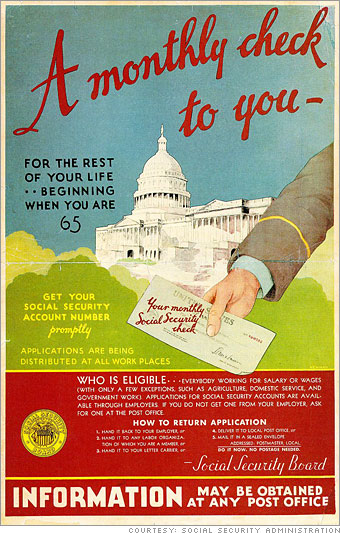
Social Security under attack from Wall Street


Economist Dean Baker exposes efforts to "reform" Social Security in a column from The Guardian:

Redefining Chutzpah: Wall Street Goes After Social Security, Again
By Dean Baker

January 12, 2009, The Guardian Unlimited
http://www.guardian.co.uk/commentisfree/cifamerica/2009/jan/12/us-economy-medicare-social-security

The classic definition of “chutzpah” is the kid who kills both of his parents and then begs for mercy because he is an orphan. The Wall Street crew are out to top this. After wrecking the economy with their convoluted finances, and tapping the Treasury for trillions in bailout bucks, they now want to cut Social Security and Medicare because we don’t have the money.

If there is any effort in Congress to follow-up on this talk about taking away people’s Social Security and Medicare, then there will have to be some very serious pain inflicted on the politicians in Washington. Let’s start with some facts.

Unlike Robert Rubin’s Citigroup, Social Security is solidly funded long into the future. According to the latest report from the Congressional Budget Office, it can pay all promised benefits through the year 2049, with no changes whatsoever. Even after that date it will always be able to pay benefits that are far higher than what current retirees receive.

So, the claim that Social Security is going broke is inaccurate, or in less polite circles, a lie. Workers in their 40s, 50s, and 60s have already paid for their Social Security benefits.

Many people, most notably investment banker and Concord Coalition founder Peter Peterson, have questioned the solvency of Social Security based on the fact that its trust fund is held in U.S. government bonds. Peterson and others derisively refer to these bonds as “IOUs.”

Of course all bonds can be called IOUs, but U.S. government bonds are considered the safest asset in the world. Mr. Peterson and his followers apparently want the government to default on the bonds held by the Social Security trust fund.

There is no reason that these bonds cannot be paid back, but if there is a serious push to default on the bonds held by the trust fund, then we should insist that Peter Peterson and other wealthy people who hold government bonds also share in the pain from default. Instead of having a full default on the trust fund bonds and full payment on the bonds held by Mr. Peterson, maybe we should make everyone take a 15 percent haircut, getting back 85 percent of the value of their bonds.

There would be substantial consequences in financial markets from such a default on U.S. government debt. But the tens of millions of retirees who lose benefits from a default on the bonds held by Social Security can act to ensure that the financial markets feel consequences as well.

Although Social Security is paid for long into the future, Medicare does face problems due to the explosion of private sector health care costs. The way to address Medicare’s shortfall is to fix the private health care system, as President Obama has pledged to do. If health care costs are contained, so that they only grow due to the aging of the population, and otherwise move in line with per capita income, then Medicare will be an affordable program. The problem is not the aging of the population, the problem is a broken health care system.

Every other wealthy country in the world has managed to contain its health care costs and provide care to its population that is as good or better than what people in the United States receive. If it were not for the political power of the pharmaceutical, insurance, and doctors’ lobbies, we would have fixed health care long ago. If Congress cannot stand up to these special interest groups, then why not just let retirees take advantage of the health care systems in countries with less corrupt political systems?

The latest round of attacks on Social Security and Medicare are especially pernicious because they come at a time when the baby boom cohorts have just seen much of their wealth disappear due to the collapse of the housing bubble and the stock market plunge. Tens of millions of baby boomers who thought they were well-prepared for retirement two years ago now find themselves with little or no home equity and very little left in their retirement funds. As a result, they will be almost totally dependent on Social Security and Medicare.

The attacks are made even worse by the fact that the attackers, people like Robert Rubin and Peter Peterson, promoted policies that led to this collapse, and personally profited to the tune of tens, or even hundreds, of millions of dollars. In other words, after pushing the economy into a severe recession and destroying the life’s savings of tens of millions of working families, the Wall Street crew now wants to take away their Social Security and Medicare. This can almost make killing your parents look like a petty offense.

http://www.cepr.net/index.php/op-eds-&-columns/op-eds-&-columns/redefining-chutzpah:-wall-street-goes-after-social-security,-again/

Dean Baker is the co-director of the Center for Economic and Policy Research (CEPR). He is the author of The Conservative Nanny State: How the Wealthy Use the Government to Stay Rich and Get Richer. He also has a blog on the American Prospect, "Beat the Press," where he discusses the media's coverage of economic issues.

Saturday, January 17, 2009

Make America Happen - Again


FDR’s Response to Great Depression Offers Lessons for Today

Washington, DC — The American Federation of State, County and Muncipal Employees has released a new video highlighting the lessons to be learned from Franklin D. Roosevelt’s response to the Great Depression. The video, entitled “Make America Happen,” links FDR’s New Deal with President-elect Barack Obama’s calls for bold action and civic engagement in response to our present crisis.

The video is part of AFSCME’s “Make America Happen” campaign to support President-elect Obama’s efforts to revitalize our economy, provide health care for all and strengthen the middle class.

The “Make America Happen” campaign will build the grassroots support needed to enact the bold programs that will be necessary to address the national crisis we face today. With Barack Obama in the White House and a new Congress in place, working families have an historic chance to affect a major shift in American politics.

AFSCME President Gerald McEntee said, “FDR’s leadership inspired a generation and helped us get America’s economy back on track. Barack Obama offers our generation of Americans bold leadership and new solutions to address the crisis we currently face.”

McEntee added, “It’s up to each of us right now to make the most of this critical time.”

America is in our worst economic crisis since the Great Depression. We have overcome great challenges before, and we can do so again. Join the campaign!

Sign the Make America Happen petition to:

Jumpstart the Economy: A bold economic recovery plan that creates jobs and protects vital services such as health care, education and law enforcement.
Make Health Care Affordable: Guaranteed quality, affordable health care everyone can count on is key to economic recovery.
Rebuild the Middle Class: Workers should be free to join unions and bargain for better wages and benefits. Unions are a ticket to the middle class and raise the standard of living for all. Pass the Employee Free Choice Act.

http://www.afscme.org/makeamericahappen/

The Case for Big Government

Jeff Madrick argues for an activist role by government in a new book. Here's a description of The Case for Big Government from the publisher's website:

Political conservatives have long believed that the best government is a small government. But if this were true, noted economist Jeff Madrick argues, the nation would not be experiencing stagnant wages, rising health care costs, increasing unemployment, and concentrations of wealth for a narrow elite. In this perceptive and eye-opening book, Madrick proves that an engaged government--a big government of high taxes and wise regulations--is necessary for the social and economic answers that Americans desperately need in changing times. He shows that the big governments of past eras fostered greatness and prosperity, while weak, laissez-faire governments marked periods of corruption and exploitation. The Case for Big Government considers whether the government can adjust its current policies and set the country right.

Madrick explains why politics and economics should go hand in hand; why America benefits when the government actively nourishes economic growth; and why America must reject free market orthodoxy and adopt ambitious government-centered programs. He looks critically at today's politicians--at Republicans seeking to revive nineteenth-century principles, and at Democrats who are abandoning the pioneering efforts of the Great Society. Madrick paints a devastating portrait of the nation's declining social opportunities and how the economy has failed its workers. He demonstrates that the government must correct itself to address these serious issues.

A practical call to arms, The Case for Big Government asks for innovation, experimentation, and a willingness to fail. The book sets aside ideology and proposes bold steps to ensure the nation's vitality.

Jeff Madrick's most recent book is Why Economies Grow. He is a regular contributor to the New York Review of Books and a former economics columnist for the New York Times. He is editor of Challenge magazine and senior fellow at the New School's Schwartz Center for Economic Policy Analysis.

http://press.princeton.edu/titles/8730.html

Read the first chapter of the Case for Big Government at:

http://press.princeton.edu/chapters/s8730.pdf