
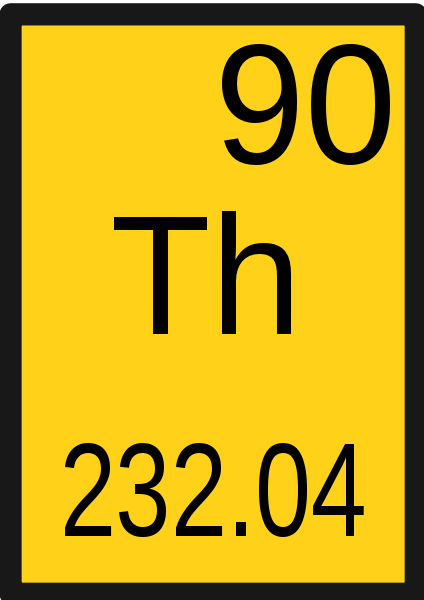
Kent Garber, writing in a recent edition of U.S. News and World Report, calls attention to a nuclear fuel with the potential to revitalize the peaceful use of atomic energy. Thorium has tremendous potential as a replacement for uranium in the nuclear industry. Senate Majority Leader Harry Reid (D-NV) and Senator Orrin Hatch (R-UT) are the bipartisan sponsors of a bill to fund thorium research.
Garber writes:
In the midst of renewed global interest in nuclear energy, a long-overlooked nuclear fuel, thorium, is being re-examined as a potential solution to some of the industry's most daunting problems, including disposal of wastes.
Widely available in the sandy beaches of India, Australia, and the United States, among other places, thorium is a naturally occurring, slightly radioactive element that is being heralded by advocates as a safer alternative to uranium that could help limit the production of nuclear waste and prevent nuclear technology from being used for weapons rather than energy.
Though many nuclear scientists have known about thorium's potential for decades—it was briefly used in the 1970s at the first U.S. commercial reactor in Shippingport, Pa.—it never caught on commercially. Today, however, with nearly three dozen nuclear reactors under construction worldwide and plans for at least two dozen more, world leaders are facing mounting pressure to make sure that the nuclear industry's expansion takes place as safely and cleanly as possible.
Could thorium be the solution? Some politicians and businesses hope so. Earlier this month, Nevada Sen. Harry Reid and Utah Sen. Orrin Hatch introduced a bill (S.3680) would set aside $250 million for research and development of thorium fuels.
Abroad, interest in thorium is even greater. The Indian government publicly has said that it wants to promote new nuclear plants running on thorium to help meet its soaring energy needs. Russia, France, the United Arab Emirates, and many others also have expressed interest.
Proponents say thorium has multiple advantages over uranium fuel. Because it is consumed more slowly in nuclear reactions than uranium, it has the potential to cut the volume of nuclear waste produced in half. Unlike a uranium reaction, a thorium fuel reaction doesn't produce weapons-usable plutonium, which would allay concerns about developing countries pursuing nuclear weapons under the pretext of nuclear energy. And proponents also say that thorium fuel could be used in new and existing reactors without companies having to make major changes to their reactor designs or fork out money for retrofits.
The dilemma of nuclear waste disposal, a longtime political lightning rod, is part of the reason no new nuclear plant has been approved for construction in the United States in some 30 years. The federal government's decades-old plan to build a nuclear waste repository at Yucca Mountain, Nev., remains stuck in limbo, and many observers speculate that the repository will never get built. Thorium would not eliminate the problem but, at least in theory, could reduce the amount of waste that would need disposal.
At the moment, thorium isn't quite ready for commercial use. The research is not yet complete, and approval of thorium fuel by the U.S. government still remains at least several years off. But some surprising international partnerships already are yielding promising developments.
http://www.usnews.com/articles/news/2008/10/14/some-nuclear-energy-backers-say-uranium-alternative-could-be-a-magic-bullet.html
See link to text of S. 3680 - Thorium Energy Independence and Security Act http://thomas.loc.gov/cgi-bin/query/z?c110:S.3680:
Hat tip www.pronucleardemocrats.blogspot.com





3 comments:
If thorium reactors get underway soon, they won't have to look very far for a source of fuel as the US Gov't has 32216 metric tones of thorium buried underground:
http://thoriumenergy.blogspot.com/2006/04/how-much-thorium-would-it-take-to.html
Calculated to be enough potential energy to power the world for 2 years.
So far there are five potential designs to incorporate Thorium into nuclear fuels, The Radkowsky seed and blanket design that retrofits into existing light water reactors, Molten Salt Reactors, which when run on Th are referred to as Liquid Fluoride Thorium Reactors, Pebble bed reactors, the SSTAR/4S-type small reactors and the accelerator driven system proposed in Norway. All these systems have technical challenges and need for greater development. They all have potential for satisfying different niches in energy production. The LFTR probably holds the greatest promise, the Seed and Blanket holds somewhat less benefit. However, the former is years if not decades away from development and there will be a thousand light water reactors on the planet by that point.
I like the Lftr. The LFTR is a very simple, efficient, and elegant type of reactor. It can use any kind of nuclear fuel, bomb material, or nuclear waste product to produce very high temperature heat and at the same time breed more fuel in the bargain. This thrifty approach to nuclear energy greatly appeals to me, but I became even more interested in the LFTR when the details of a new patent were revealed by Dr LeBlanc. It opens up the possibility of building a reactor that can run for 30 years without refueling in an unattended mode sited underground while it breeds new fuel within the thorium structure of the reactor itself. In order to get to this U233 that has been produced inside the very walls of the reactor containment vessel, a proliferator must destroy the reactor, chop it up into small pieces while enduring heavy gamma radiation exposure without being detected, then reprocess these reactor pieces using isotopic separation since the U233 is denatured with enough U238 to make chemical separation of bomb grade U233 impossible. Now, this is a tall order for any proliferator and may just be an impossible assignment.
At the end of the service life of the Lftr, the reactor vessel is sent back to the factory where it is reduced to liquid fluoride salts that become the feedstock of a next new Lftr. This feedstock can only be used by the new Lftr and not for bombs. The waste products are held at the factory for a few hundred years to cool down before they are mined for the many precious elements contained within like platinum and iridium. Now that’s what I call a safe, efficient and thrifty mode of operation.
Post a Comment